Dynamic@dnmce.com
The ship shore power system primarily consists of three components: the onshore power supply system, the ship-shore interaction section, and the ship power receiving system. The schematic diagram of the ship shore power system is illustrated in Figure 1.
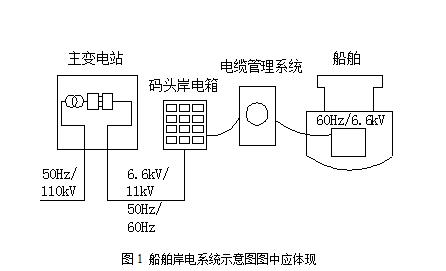
图1 船舶岸电系统示意图
The onshore power supply system transmits electric power from the high-voltage substation to the connection point near the ship, namely the shore power connection box at the dock (SPS shore power supply). It performs functions such as voltage level conversion, frequency conversion, and uninterrupted switching with the ship power receiving system.
This section consists of cables and equipment connecting the onshore connection point and the onboard power receiving device. The cable connection equipment shall meet the requirements for quick connection and storage, and shall be stored on board, on shore or on a barge when not in use.
A shore power receiving system is fixedly installed on the basis of the ship’s original power distribution system, including cable winches, onboard transformers, and relevant electrical management systems. The voltage levels of marine power station generators are classified into high voltage and low voltage.The voltage levels of high-voltage marine power stations are 11kV/6.6kV/60Hz or 6kV/50Hz; those of low-voltage marine power stations are 400V/50Hz or 440V/60Hz.
This paper analyzes the technical characteristics of onshore high-voltage and low-voltage power supply modes adopted by major domestic and foreign ports and terminals, and compares the technical advancement, adaptability, advantages and disadvantages of various shore power technologies, as shown in Table 1.
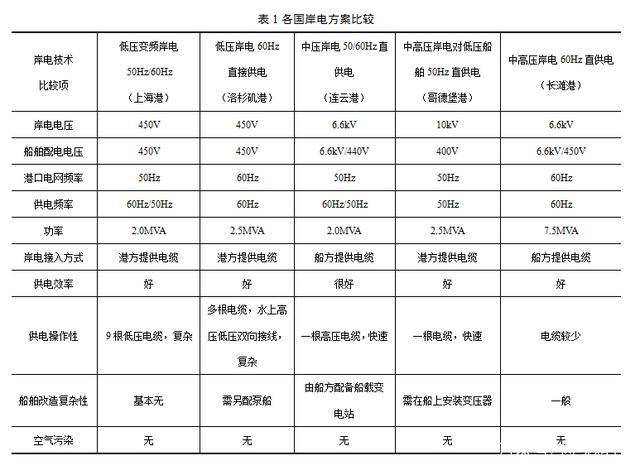
表1 各国岸电方案比较
According to the comparative analysis in Table 1, the Port of Los Angeles, the Port of Gothenburg, the Port of Hamburg, as well as some small canal ports, have all attempted to implement ship shore power connection, and a number of ports in China have also carried out relevant practice.
Nevertheless, foreign solutions have no frequency conversion function and thus are not applicable to China’s operating conditions. The Port of Shanghai adopts frequency conversion technology and requires nine low-voltage cables for power supply, leading to relatively complex operation. The Port of Lianyungang also applies frequency conversion technology and can provide two voltage levels: 6.6 kV and 440 V.
For high-voltage ships with a distribution voltage of 6.6 kV / 11 kV, high-voltage shore power supply is a relatively convenient option. However, most ships around the world adopt the 440 V low-voltage standard, so the variable-frequency low-voltage power supply mode is more widely used.
Variable-frequency shore power supply with selectable 60 Hz / 50 Hz can meet the power supply needs of more ship types. It boasts excellent technical performance and operability, high engineering technical sophistication, and broad prospects for application and popularization.
National Service Hotline
0511-84519618
address:No. 101 Nanxu Avenue, Runzhou District, Zhenjiang City, Jiangsu Province